

Base64 in Used-Equipment Attachments: Read the Scope
2026-11-04
Base64 in Used-Equipment Attachments: Read the Scope
What the Descriptor Actually Says
When a used-equipment listing or a seller's message includes an attachment described as Base64, the first question is not "what does it contain?" but "what kind of statement is the descriptor making?" Base64 is a binary-to-text encoding: a method for representing arbitrary byte sequences as printable ASCII characters so they can travel through systems that expect text. The Python standard library documentation describes the base64 module as providing functions for encoding binary data to printable ASCII characters and decoding such encodings back to binary data, covering the schemes specified in RFC 4648 as well as Base85 variants (Python base64 module documentation). RFC 4648 itself describes Base16, Base32, and Base64 as data encodings and discusses line feeds, padding, non-alphabet characters, and canonical forms (RFC 4648, October 2006). Neither source describes Base64 as a signature, a certificate, or a proof of who created a file.
That distinction matters in a used-robot transaction because the attachment might be a backup file, a parameter export, a log archive, or a scanned document. The encoding tells you how the bytes were made transmittable, not where they came from. A seller who says "this file is Base64-encoded" has told you about the transport representation, not about the document's identity or the sender's authenticity. Treating the encoding label as a provenance claim is a category error that can lead a buyer to over-trust a file simply because it arrived in a familiar text wrapper.
Binary-to-Text Encoding Versus Document Identity
Document identity is a separate question: which artifact does the contributor mean, and what supports a proposed comparison with another artifact? A filename, timestamp or version label can help locate a claim, but none automatically proves identical content. Canonical Base64 representation also depends on the specified encoding conventions, not merely the alphabet name. Keep the description of an encoding separate from evidence about the intended file.
Consider a hypothetical archived attachment: a seller offers a used controller and includes a file named controller_backup_v3.b64. The descriptor says the file is Base64-encoded. A buyer might reasonably ask: encoded from what original format? Is the original a proprietary backup, a plain-text parameter list, or something else? The Base64 label does not answer those questions. It only tells you that the bytes were transformed into ASCII characters for transmission. To learn what the file actually represents, you would need the original binary or a clear description of the source format — and even then, the encoding itself provides no evidence of who created the original.

Sender Authenticity Is Not Established by Encoding
Sender authenticity concerns who made or sent a claim. Base64 encoding does not itself create an authentication mechanism. Its payload could contain a signed document or a certificate, but that would be additional content with its own interpretation and verification requirements. The encoding label alone does not establish that such content exists, was checked or identifies the sender.
A contributor may describe the encoding to help the recipient understand the transfer format. The editor should assess the actual statement without guessing the contributor's intention. If the attachment's source or relevance is unclear, ask a bounded documentation question. This article identifies no real seller, received attachment or verified communication channel.
How Base64 Works at a Conceptual Level
Base64 maps groups of three bytes (24 bits) to four printable ASCII characters, using an alphabet of 64 symbols. RFC 4648 defines the standard alphabet and also a URL- and filename-safe variant, and it discusses how padding characters are used when the input length is not a multiple of three (RFC 4648, sections 4–5). The Python module supports both alphabets and also offers Base32 and Base16 for different trade-offs between output length and character set (Python base64 documentation). These are technical choices about representation, not about trust. A file encoded with the URL-safe alphabet is still just a file; the alphabet choice does not make it more or less authentic.
What this means in practice is that a buyer who receives a Base64 attachment should first ask what the original file was, then ask why it was encoded, and only then consider whether to decode it. Decoding is a mechanical step that reverses the encoding; it does not add information about the file's origin. If the original was a proprietary backup, decoding it without the appropriate software may produce an unreadable binary blob. If the original was a text document, decoding it may reveal readable content — but that content is still just the content the sender chose to include, not an independent verification of anything.
A Clearly Hypothetical Archived Attachment
Imagine an entirely fictional archive entry labeled arm_controller_archive.b64. Its description says the original was a controller backup and that the payload uses Base64. Those are statements in the fictional descriptor, not an inspection result. The description alone does not prove that a well-formed encoded payload was supplied, or that it represents the claimed backup. No decoding or file validation is performed here.
If someone asks whether the fictional archive entry corresponds to a controller currently being discussed, retain that question separately from the encoding description. The responsible contributor could identify the artifact and explain the evidence supporting its relevance. This article prescribes no backup loading, parameter comparison or interaction with equipment software. An unperformed comparison remains unperformed, even when the outer representation is familiar.
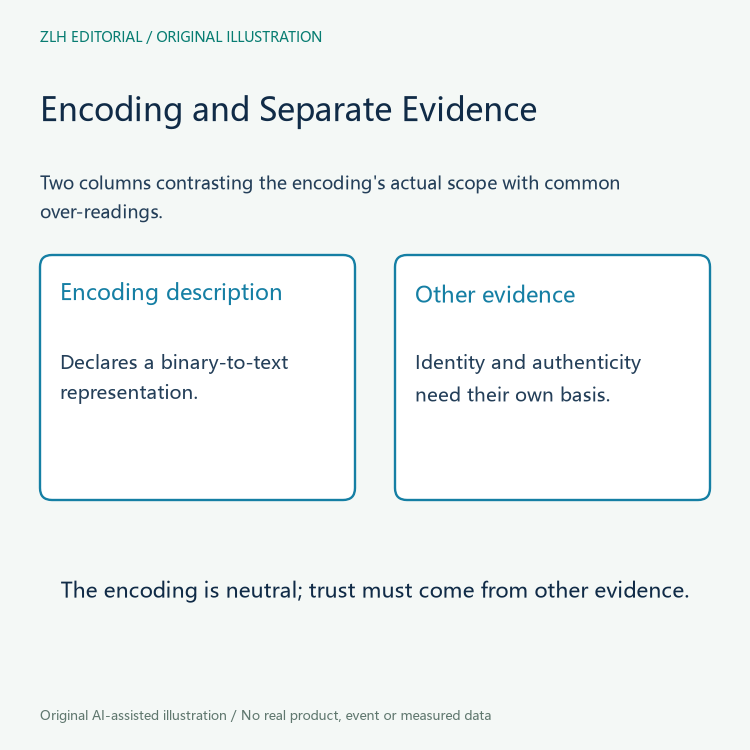
Keeping Encoding, Identity, and Authenticity in Separate Columns
The most useful habit in reviewing used-equipment attachments is to maintain three separate columns of thought. The first column is encoding: how were the bytes represented for transmission? The second is identity: is this the same file that was previously described, referenced, or agreed upon? The third is authenticity: who sent it, and through what channel? Base64 belongs only in the first column. It does not migrate into the second or third without additional evidence.
This separation is not just academic. In a transaction, a buyer who conflates the columns may accept a file as "verified" because it arrived in a familiar encoding, or may reject a file as "untrustworthy" because it was binary rather than text. Both reactions skip the actual questions: what does the file contain, how was it produced, and can its contents be checked against the equipment? A seller who is transparent about the encoding but vague about the source format or the comparison method is not necessarily hiding something — but the buyer should still keep the questions open until the file's identity and relevance are established through the appropriate technical process.
Related reading is available in the used-equipment documentation articles and the article directory. These are general category links; the present discussion concerns the encoding descriptor and the separate questions it leaves open.
Questions to Ask Before Treating an Attachment as Evidence
When a used-robot attachment is described as Base64-encoded, a buyer can ask a short set of questions that respect the encoding's actual scope. What was the original file format before encoding? Why was it encoded — for transport, for storage, or for compatibility with a particular system? Who produced the original file, and in what context? Can the decoded content be compared with the equipment's current configuration, and if so, using what software and method? Has the file's identity been recorded anywhere else in the transaction, such as in a previous message, a catalog entry, or a handover checklist?
The descriptor is a starting point for reading the supplied material. If an answer remains unavailable, record the specific unresolved question rather than assigning a motive or a quality grade to the contributor. Keeping encoding, artifact identity and sender evidence separate makes the note clearer without pretending that any attachment was authenticated in this article.


