

Used Robot Software Handover: Programs and Installations
2026-11-04
Used Robot Software Handover: Programs and Installations
Used Robot Software Handover can become confusing when a seller supplies a folder described simply as “the robot program.” The folder may contain several kinds of records, and a familiar filename does not explain how they relate. Before agreeing that the software documentation is complete, the buyer needs an intelligible account of the program and its associated installation. This article reads Universal Robots PolyScope 5 documentation in the SW5_26 manual context. Its fictional handover example concerns document organization; it gives no instructions for loading files or operating a robot.
Ask which program is associated with which installation
The official Program and Installation Manager description treats programs and installations as separate managed objects. It also explains that a robot can have several installation files and that created programs use the active installation. This makes the relationship a useful handover question rather than something to infer from a folder title.
A proposed document register can give the program and installation separate entries, then record the association stated by the seller. Retain the original names and the manual context used to explain them. If the seller supplies several installations, ask which one the handover statement concerns. An editor should not choose the newest-looking name or assume that matching prefixes prove a relationship. Those are visual clues in a document set, not evidence that the intended pairing has been established.
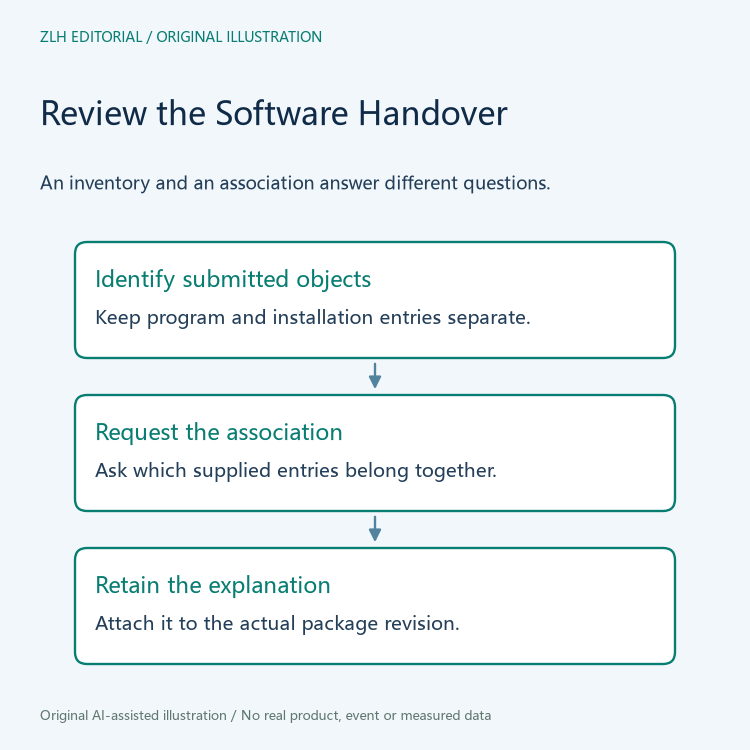
Distinguish a file inventory from a relationship account
A directory inventory answers what the submitted package contains. A relationship account answers how the contributor says those items belong together. Both can be useful, but they solve different problems. A list containing one program and two installations is still ambiguous if the seller has not identified the intended association. Renaming the folder to “complete backup” does not supply that missing explanation.
Use a narrow clarification request: identify the particular program entry, name the installation entry it is supposed to use, and ask the seller to confirm that association in the handover record. Keep the response with the package revision to which it refers. If the response refers to a different export or a later machine state, retain that difference explicitly. A tidy table should not combine answers from unrelated submissions into a seemingly continuous account.
Read a support archive according to its stated purpose
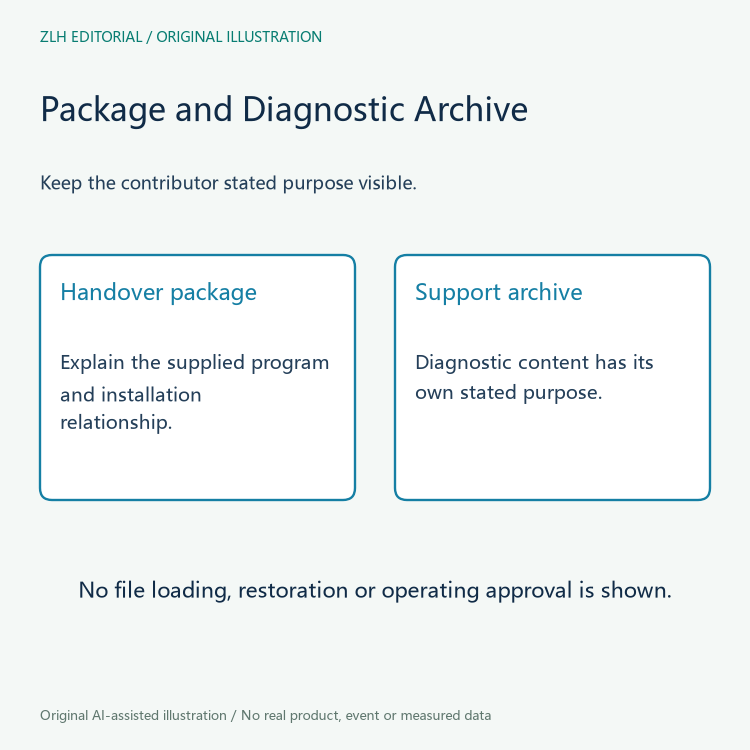
The manual's Log Tab description says that exported error reports include a user program and installation among other diagnostic material. Its technical-support-file description also includes configurations, programs and installations. These descriptions explain why such records may appear in diagnostic material. They do not make every diagnostic archive a complete commercial handover.
The buyer's document register should therefore identify an archive's stated origin and purpose. Is the seller supplying an identified program-and-installation package, or pointing to diagnostic material that happens to contain related objects? Ask for the intended relationship instead of treating those descriptions as interchangeable. A support file's presence does not answer whether the transaction's agreed documentation has been supplied, whether the seller has the necessary rights, or whether a later user may safely operate the equipment.
Review a fictional package with an unexplained duplicate
Imagine a fictional listing called Robot Cedar. The seller's handover note names Program Cedar, while the attachment inventory contains Installation Cedar and Installation Cedar Old. A separate support archive is also listed. No supplied statement links the program to either installation, and the word “Old” has no explained meaning. The reviewer can identify this documentary gap without opening a controller interface or attempting to run any supplied material.
The next useful deliverable is a corrected association note from the contributor. It should identify the package revision being discussed and explain which installation entry the seller intends. If an obsolete entry remains for historical context, label its role in the register instead of silently removing it from the evidence trail. If a replacement package arrives, distinguish that submission from an explanation of the original package. This avoids reporting a changed input as though it had always been part of the first delivery.
State what the handover review actually resolved
A bounded review conclusion can say that the supplied inventory now distinguishes the program, installation and diagnostic archive, and that the contributor's association statement is attached. It can also identify any unresolved discrepancy. That conclusion is more informative than a general “software accepted” checkbox because another reader can see the specific relationship that was clarified.
Document clarity does not establish technical compatibility, current machine configuration or operating authorization. Those questions require their own responsible assessment and evidence. The review here ends with an intelligible submission record. It does not apply safety settings, restore data, validate a program or certify a transaction. Keep those boundaries visible when summarizing the result to a buyer who was not present for the clarification exchange.
The site's reference category and related-information category offer further navigation. When a later handover revision replaces a program or installation entry, revisit the stated association rather than copying the earlier conclusion automatically. The value of the register lies in preserving what each contributor actually supplied and explained.


